
Introduction
Greek architecture stands as one of the most enduring legacies of the ancient world. Known for its harmony, proportion, and elegance, it has influenced countless architectural styles across history; from Roman temples to today’s neoclassical government buildings.
At its core, this is just about building structures but about reflecting cultural values such as order, beauty, and balance.
In this article, we’ll explore the origins, key features, iconic examples, and the lasting impact of Greek architecture.
Table of Contents
The Origins
Greek architecture developed between 900 BCE and 100 BCE, during the Archaic, Classical, and Hellenistic periods. Early structures were simple wooden temples, but over time, stone and marble replaced wood, creating monuments that have survived for thousands of years.
Temples were the most important type of building, dedicated to gods and goddesses. Unlike modern buildings, Greek temples were designed more as homes for the deity rather than spaces for large gatherings.
Key Features
1. The Three Classical Orders
Perhaps the most recognizable feature of Greek architecture is the column. The Greeks developed three distinct “orders” of columns:
Doric Order: Strong, simple, and without bases. Doric columns gave buildings a sense of stability and dignity.
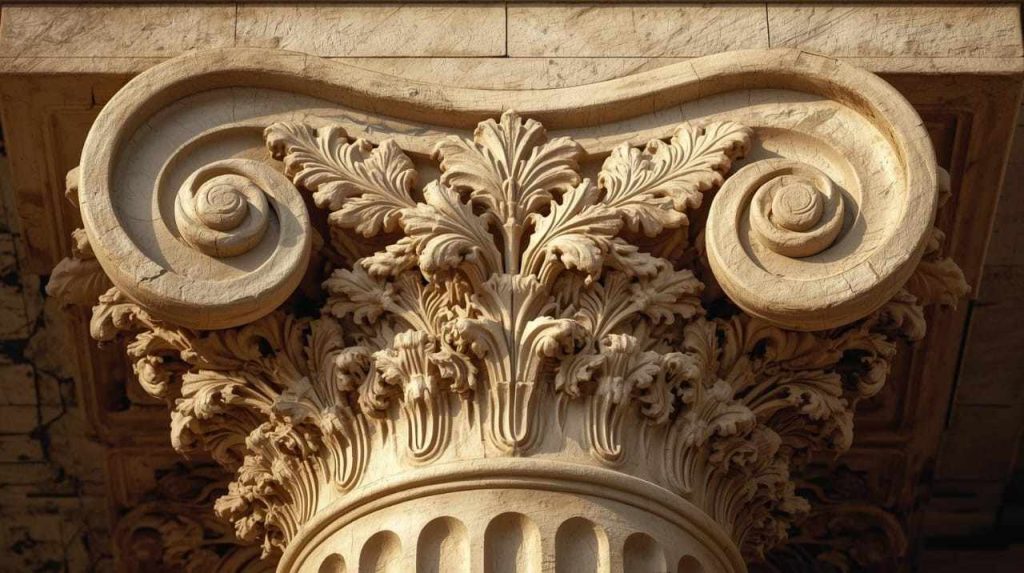
Ionic Order: More slender, with scroll-like capitals known as volutes. Ionic designs were elegant and graceful.
Corinthian Order: The most decorative, with intricate carvings of acanthus leaves. Popular in later periods and widely copied by the Romans.
2. Symmetry and Proportion
This believed beauty came from mathematical precision. The Golden Ratio was often used to achieve perfect balance, especially in temples like the Parthenon.
3. Materials and Techniques
Early structures used wood and mudbrick, but marble and limestone became dominant. Their precise stone-cutting and joining techniques allowed buildings to endure centuries.
Read more about History of Architecture click the link
4. Decorative Elements
Friezes, pediments, and sculptures were used not just for decoration but to tell mythological stories. Relief carvings often depicted battles, gods, and everyday life.

Famous Examples of G/ A
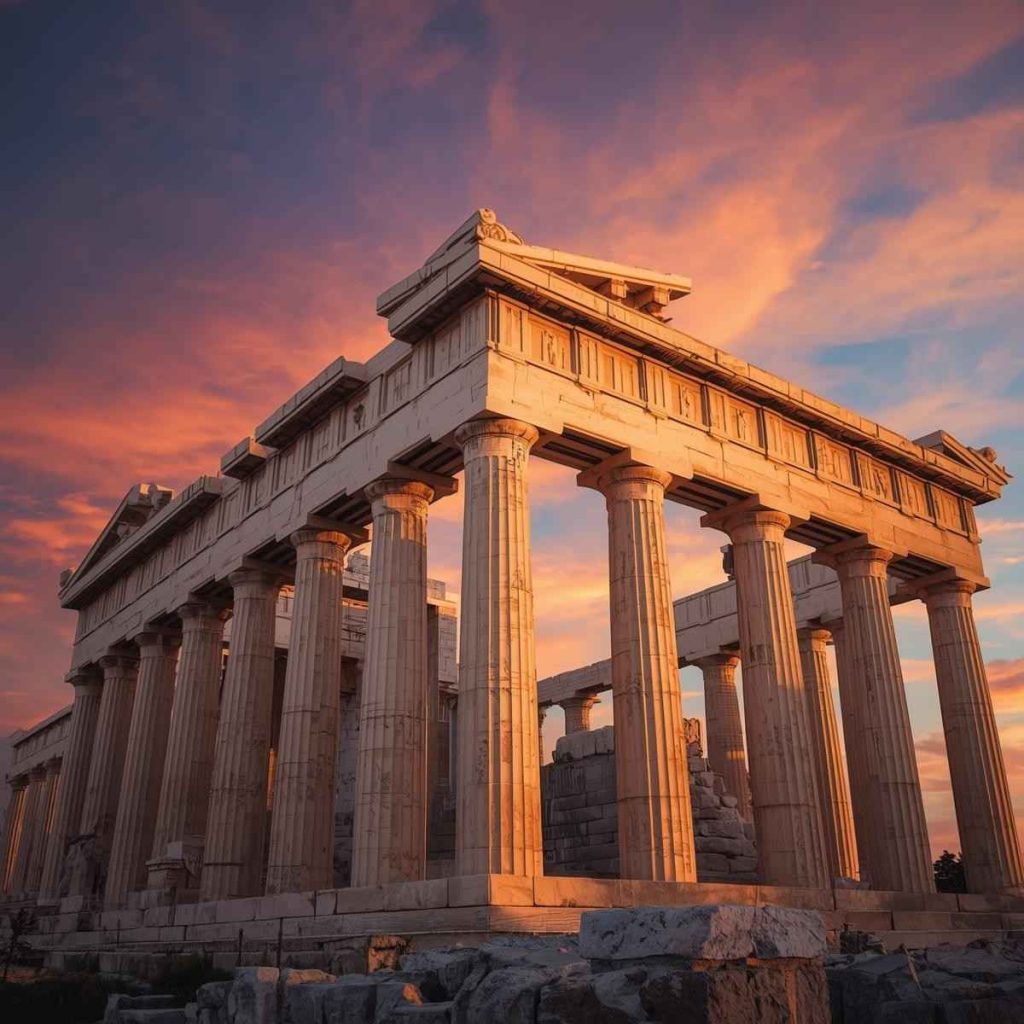
1. The Parthenon (Athens, 447–432 BCE)
- Dedicated to Athena, the goddess of wisdom and war.
- Built during the Golden Age of Athens under Pericles.
- Mostly Doric, with subtle Ionic features (like the inner frieze).
- Famous for its perfect proportions and the use of optical corrections—columns slightly curved inward so they appear straight to the human eye.
2. The Erechtheion (Athens, 421–406 BCE)
- Built on the Acropolis, dedicated to both Athena and Poseidon.
- Known for its Porch of the Caryatids, where six sculpted female figures act as supporting columns.
- Irregular design due to uneven terrain, showcasing Greek skill in adapting architecture to nature.
3. Temple of Hephaestus (Athens, 449 BCE)
- Overlooks the ancient Agora of Athens.
- Considered the best-preserved Doric temple in Greece.
- Built from marble, with rich sculptural decorations depicting the Labors of Heracles and Theseus.
4. Temple of Apollo at Delphi (4th century BCE)
- A sacred site of the Oracle of Apollo, central to Greek religion and culture.
- Located on Mount Parnassus, blending architecture with dramatic natural surroundings.
- Symbolized the connection between architecture and spiritual life in Greece.
5. Temple of Olympian Zeus (Athens, 2nd century CE)
- One of the largest temples in the ancient world.
- Took over 600 years to complete due to wars and political struggles.
- Originally featured 104 massive Corinthian columns (only 15 remain standing today).
6. Temple of Hera (Paestum, Italy, c. 550 BCE)
- A Doric temple in southern Italy, showing how Greek architecture spread to colonies.
- Massive and monumental, with thick columns that emphasized strength.
7. Stoa of Attalos (Athens, 2nd century BCE, reconstructed 1950s)
- A covered walkway (stoa), serving as a public marketplace and meeting space.
- Showed how Greek architecture wasn’t just religious but also civic and social.
- Reconstructed to house the Agora Museum, giving modern visitors a sense of ancient Greek urban life.
8. The Theater of Epidaurus (4th century BCE)
- A masterpiece of Greek theater design.
- Famous for its perfect acoustics, where even whispers from the stage can be heard in the highest seats.
- Shows how Greek architecture extended beyond temples into cultural and entertainment spaces.
The Legacy of G/ A
The influence of Greek architecture is seen across civilizations:
- Roman Architecture: Adopted and adapted Greek orders, adding arches, domes, and concrete.
- Neoclassical Movement: In the 18th–19th centuries, architects in Europe and America revived Greek styles for universities, museums, and government buildings.
- Modern Architecture: Concepts of symmetry, balance, and open public spaces still echo Greek ideals.
Examples today include the U.S. Capitol Building, the British Museum, and countless courthouses worldwide.
Why Greek Architecture Still Matters
Greek architecture endures because it represents timeless beauty, cultural identity, and innovation. Its principles of proportion and harmony continue to guide architects and designers today. Whether in a grand museum or a modern minimalist home, echoes of Greek design remain part of our built environment.
Conclusion
Greek architecture is more than just columns and temples; it’s a philosophy of design that connects aesthetics with meaning. From the Doric strength of the Parthenon to the decorative Corinthian style that spread across Rome, its legacy continues to shape the world’s architecture.
By studying Greek architecture, we not only admire ancient beauty but also understand the roots of modern design.
FAQs.
1. What are the three main types of Greek columns?
The three main column styles, or orders, are Doric, Ionic, and Corinthian. Each has its own unique proportions and decorative details.
2. Why is the Parthenon important in Greek architecture?
The Parthenon represents the peak of Classical Greek architecture, showcasing perfect proportions, detailed sculptures, and Doric design principles.
3. How did Greek architecture influence modern buildings?
Greek principles of balance, proportion, and use of columns inspired Roman, Renaissance, and Neoclassical architecture, influencing everything from government buildings to museums.