Islamic Architecture: A Historical Overview
Islamic Architecture History, arose in the 7th century, fusing Byzantine, Persian, and Roman elements into a style emphasizing geometry, arabesques, and spiritual harmony. Over 1,300 years, it evolved through empires, featuring domes, minarets, and muqarnas that symbolize divine unity. This overview traces its milestones, innovations, and global impact.

Read More about History of Architecture click here.
Core Features
- Domes and Minarets: Iconic golden domes like the Dome of the Rock (691 CE) and soaring minarets for the call to prayer.
- Geometric Patterns: Intricate tiles, stucco, and calligraphy avoiding human forms, seen in Córdoba’s horseshoe arches.
- Courtyards and Iwans: Open spaces for community and vaulted halls promoting light and airflow.

Table of Contents
Key Eras
- Early (7th-9th CE): Prophet’s Mosque (Medina) and Great Mosque of Damascus pioneered hypostyle halls.
- Golden Age (10th-13th CE): Alhambra’s plasterwork and Isfahan’s muqarnas.
- Later Empires: Taj Mahal (Mughal, 1632 CE) and Süleymaniye Mosque (Ottoman, 1557 CE).
Early Foundations (7th-9th Century)
Islamic Architecture History: The early foundations of Islamic architecture (7th-9th century) laid the groundwork during the Rashidun and Umayyad caliphates, adapting pre-Islamic structures into mosques emphasizing simplicity, communal prayer, and qibla orientation toward Mecca.
Key innovations included hypostyle halls, mihrabs, and the first monumental domes, blending Byzantine craftsmanship with emerging Islamic aesthetics like vegetal motifs and marble revetments. This period set enduring principles of light, space, and geometry across the expanding empire.

photographed by Wojciech Kocot in 2018
Defining Structures of Islamic Architecture History
- Prophet’s Mosque, Medina (622 CE): Simple courtyard with palm-trunk columns and mud-brick walls, expanded under Umayyads into a vast hypostyle prototype.
- Dome of the Rock, Jerusalem (691 CE): Octagonal shrine with gilded dome over the Foundation Stone, featuring marble columns, glass mosaics of paradise gardens, and inscribed Quranic verses.
- Great Mosque of Damascus (715 CE): Converted basilica with expansive prayer hall, horseshoe arches, and ablution fountain, introducing the mihrab niche.
Architectural Innovations of Islamic Architecture History
- Minarets Emerge: Early towers like Damascus’s for adhan calls.
- Hypostyle Halls: Rows of columns creating shaded, flexible worship spaces.
- Mosaics and Calligraphy: Non-figural decoration glorifying Allah, avoiding idolatry.
Umayyad and Abbasid Innovations (8th-10th Century)
Islamic Architecture History: Umayyad and Abbasid eras (8th-10th century) marked bold expansions in Islamic architecture, shifting from simplicity to grandeur with urban planning, engineering feats, and decorative opulence.
Umayyads in Spain and Syria pioneered horseshoe arches and vast complexes, while Abbasids in Iraq introduced circular cities and experimental forms, emphasizing scale for imperial power. These innovations influenced later styles, blending functionality with aesthetic splendor.

Iconic Umayyad Works
- Córdoba Mosque (784 CE): Forest of columns with red-and-white horseshoe arches, double tiers supporting ribbed vaults, and a mihrab of glittering mosaics.
- Qusayr Amra Palace (8th century): Desert frescoed hunting lodge with hammam domes, showcasing early secular Islamic art.
Abbasid Advances
- Great Mosque of Samarra (851 CE): World’s largest mosque with spiral minaret (Malwiya), vast courtyard, and stucco niches.
- Baghdad’s Round City: Concentric design with iwans (vaulted halls) for administration and prayer.
Key Innovations of Islamic Architecture History
- Horseshoe Arches: Elegant, structurally efficient curves seen in Córdoba.
- Spiral Minarets: Samarra’s coiled tower for adhan projection.
- Stucco and Glazed Tiles: Ornate vegetal motifs and early geometric patterns.
Golden Age Peaks (10th-13th Century)

photograph credit by respective owner Liberaler Humanist
The Golden Age of Islamic architecture (10th-13th century) flourished under Fatimid, Seljuk, and Nasrid patronage, perfecting ornamental techniques like muqarnas vaulting, luster tiles, and poetic inscriptions.
Islamic Architecture History: This era blended Persian engineering with North African artistry, creating scholarly complexes and palaces that epitomized refinement and cosmic harmony. Spanning Cairo to Granada, these peaks influenced Renaissance Europe and beyond.
Fatimid and Seljuk Masterpieces
- Al-Azhar Mosque, Cairo (970 CE): Fortress-like enclosure with stucco mihrab, domes, and minarets; evolved into a madrasa-university.
- Isfahan’s Friday Mosque (11th century): Four-iwan layout with turquoise tile domes and muqarnas portals, showcasing Seljuk geometry.

Nasrid Splendor
- Alhambra Palace, Granada (13th-14th century): Fortress-palace with Court of Lions, filigree stucco, reflecting pools, and muqarbes ceilings inscribed with “There is no victor but Allah.”
Signature Innovations of Islamic Architecture History
- Muqarnas (Honeycomb Vaulting): Stalactite-like transitions from square to dome, as in Isfahan.
- Lusterware Tiles: Iridescent ceramics in metallic hues for walls and mihrabs.
- Gardens and Water Features: Paradise motifs symbolizing Quranic rivers.
Ottoman and Mughal Mastery (14th-19th Century)

Photography credit respective ower by © Yann Forget
Islamic Architecture History: Ottoman and Mughal eras (14th-19th century) represented the zenith of Islamic architecture, with Ottomans mastering centralized domes and Mughals fusing Persian grandeur with Indian motifs.
Supported by imperial workshops, these styles emphasized symmetry, acoustics, and eternal beauty, producing timeless mausoleums and mosque complexes. Their legacy spans Istanbul to Agra, blending faith, power, and nature.
Ottoman Excellence
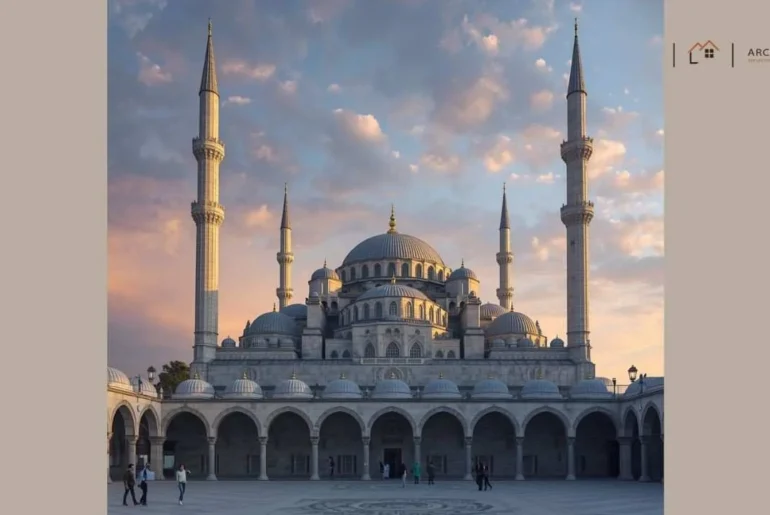
- Süleymaniye Mosque, Istanbul (1557 CE): Sinan’s masterpiece with four minarets, vast central dome (53m high), and cascading semi-domes for perfect acoustics.
- Blue Mosque (1616 CE): Six pencil minarets, Iznik tiles in 20,000 shades of blue, and marble courtyard.

To study more about Islamic Architecture. Please follow this link
Mughal Magnificence
- Taj Mahal, Agra (1632-1653 CE): Shah Jahan’s white marble mausoleum with onion domes, minarets, and charbagh gardens symbolizing paradise.
- Fatehpur Sikri (1571 CE): Akbar’s red sandstone city with Buland Darwaza gateway and Panch Mahal pavilion.
Hallmark Features
- Centralized Plans: Ottoman domes over square bays via pendentives.
- Pencil Minarets: Slender, fluted towers unique to Ottomans.
- Pietra Dura Inlays: Mughal gemstone mosaics on marble.
Modern Legacies and Revival
Modern Islamic architecture (20th-21st century) adapts classical motifs to contemporary needs, blending tradition with innovation amid urbanization, sustainability, and globalization.
Islamic Architecture History: Colonial influences spurred neo-Moorish revivals, while post-independence movements revived domes and minarets in public buildings. Today, starchitects fuse heritage with modernism, prioritizing eco-friendly designs like wind-catching towers.

Photograph credit Respective ower by Petar Milošević
20th-Century Revivals
- Neo-Moorish Styles: Hassan II Mosque, Casablanca (1993 CE), with retractable roof and laser minaret beam to Mecca.
- King Fahd Complex, Riyadh (1980s): Expansive courtyards echoing Samarra, using modern concrete.
Contemporary Icons
- Burj Khalifa, Dubai (2010): Spire evoking minarets, integrated with Islamic geometry in its perforated facade.
- Sheikh Zayed Grand Mosque, Abu Dhabi (2007): White marble expanse with floral chandeliers and world’s largest carpet.
Enduring Principles
- Sustainable Courtyards: Natural ventilation and water features for hot climates.
- Digital Ornamentation: Parametric designs generating arabesques via algorithms.
- Cultural Hubs: Madrasas evolving into museums preserving muqarnas digitally.

Photograph credit Respective ower by King of Hearts
Islamic Architecture Conclusion
Islamic architecture endures as a testament to faith, ingenuity, and cultural synthesis, evolving from Medina’s humble courtyards to Dubai’s towering spires over 1,300 years. Its core principles geometric harmony, light manipulation, and non-figural beauty transcend empires, inspiring sustainable modern designs worldwide.
Timeless Legacy
- Spiritual Unity: Domes and arabesques symbolize tawhid, uniting diverse regions from Andalusia to India.
- Engineering Marvels: Innovations like muqarnas and iwans influenced Gothic arches and Renaissance domes.
- Contemporary Relevance: Revivals in mosques and skyscrapers preserve heritage amid globalization.
FAQs on Islamic Architecture History
What defines early Islamic architecture?
How did Umayyad and Abbasid eras innovate?
What marks the Golden Age peaks?
What are Ottoman and Mughal contributions?
How does modern Islamic architecture revive traditions?
Contemporary icons like Sheikh Zayed Mosque and Burj Khalifa blend classical motifs with sustainability, using geometric patterns and courtyards in urban settings.